
Most businesses don’t struggle to see the value in cloud technology. The real challenge is figuring out which setup actually fits how they operate—and that’s where hybrid cloud solutions come in. Hybrid cloud combines private and public cloud environments, giving businesses the flexibility to run workloads where they make the most sense. But with so many vendors, configurations, and technical considerations on the table, making the right call is easier said than done.
This guide breaks down what hybrid cloud solutions are, why they’ve become a go-to model for modern enterprises, and—most importantly—how to evaluate your options so you end up with a setup that genuinely serves your business.
What Are Hybrid Cloud Solutions, and Why Do They Matter?
A hybrid cloud environment blends private cloud infrastructure (hosted on-premises or in a dedicated data center) with one or more public cloud services, such as AWS, Microsoft Azure, or Google Cloud. These environments are connected through orchestration tools and APIs, allowing data and applications to move seamlessly between them.
The appeal is straightforward. Sensitive data can stay within a private environment where compliance requirements are easier to manage, while less critical workloads can scale freely in the public cloud. You get the security and control of a private setup without sacrificing the elasticity of the public cloud.
For growing businesses, this flexibility often translates directly into cost savings and competitive agility. Gartner has consistently highlighted hybrid cloud as a dominant enterprise IT strategy, and that trend shows no signs of slowing.
How Do You Know If a Hybrid Cloud Model Is Right for You?
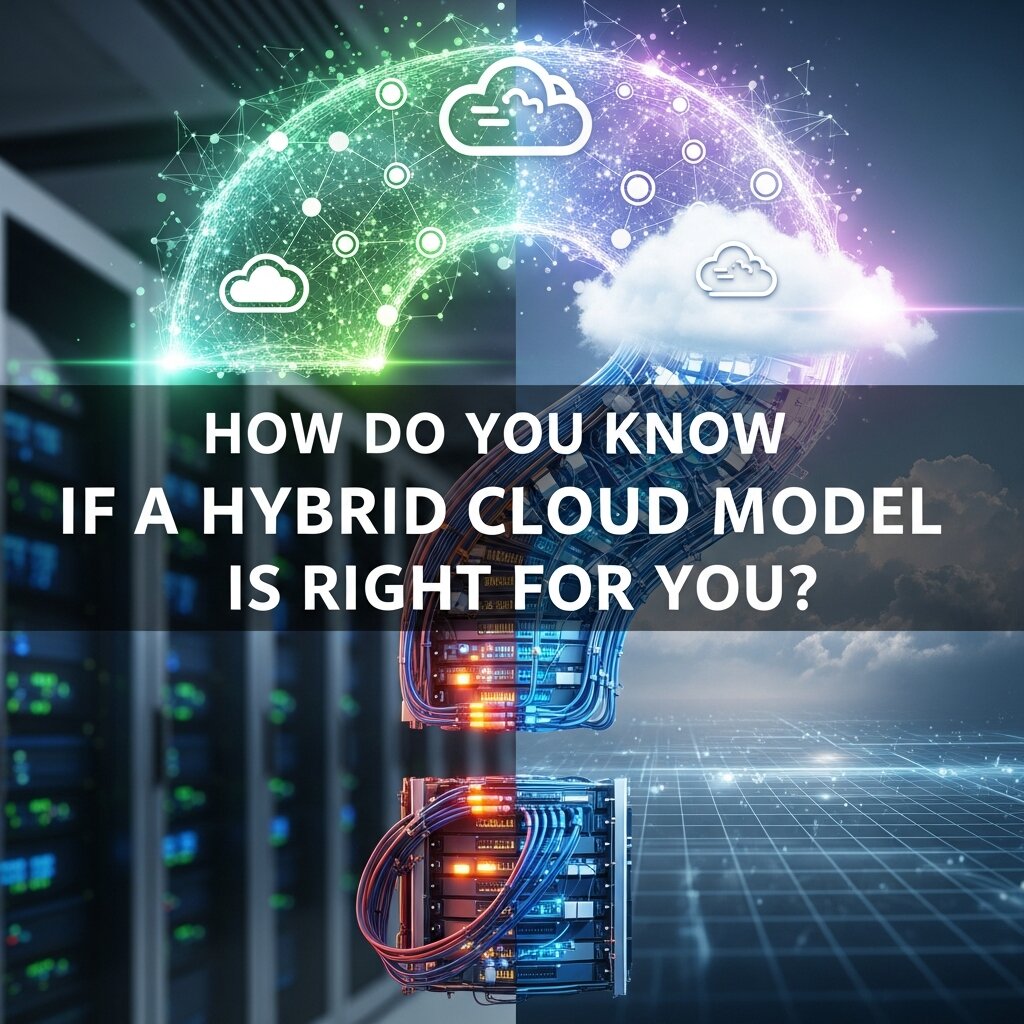 Before evaluating specific solutions, you need to assess whether a hybrid approach is even the right architecture for your business. Not every organization needs one.
Hybrid cloud solutions tend to be a strong fit when:
- You operate in a regulated industry, such as healthcare, finance, or legal services, where certain data must remain on-premises or within a private environment to meet compliance requirements.
- Your workloads are highly variable, with seasonal spikes or unpredictable demand that would be costly to support with fixed private infrastructure alone.
- You’re mid-migration, transitioning from legacy systems to the cloud but not yet ready—or able—to move everything off-premises.
- You need low-latency performance for specific applications, where proximity to end users or internal systems is critical.
If your operations are relatively simple and compliance isn’t a major concern, a straightforward public cloud setup might serve you just as well. But for most mid-size to enterprise-level businesses, hybrid cloud strikes a balance that neither model achieves on its own.
What Key Factors Should You Evaluate in a Hybrid Cloud Solution?
Workload Compatibility and Portability
One of the biggest pitfalls businesses encounter is choosing a hybrid cloud platform without first cataloging their workloads. Different applications have very different infrastructure requirements. Some run well in a containerized public cloud environment; others depend on legacy databases or real-time latency that demands on-premises hosting.
Start by auditing your existing applications and systems. Identify which workloads are cloud-ready, which require modernization, and which should stay on-premises indefinitely. This process often surfaces the need for custom IT solutions—purpose-built configurations that match your specific workload mix rather than forcing a generic setup onto a complex environment.
Workload portability also matters for the long term. Look for solutions built around open standards and container-based technologies like Kubernetes, which make it easier to shift workloads between environments as your needs evolve.
Security and Compliance Architecture
Security in a hybrid cloud environment is more nuanced than in a single-cloud setup, because you’re managing data and access policies across multiple environments simultaneously. The connection points between your private and public environments—often called the “hybrid fabric”—are a common attack surface if not properly managed.
Key questions to ask potential vendors:
- How is data encrypted in transit and at rest across both environments?
- What identity and access management (IAM) tools are included, and do they support zero-trust models?
- How does the solution support regulatory frameworks relevant to your industry (e.g., HIPAA, GDPR, SOC 2)?
If your team lacks in-house expertise in cloud security architecture, engaging IT consulting solutions early in the process can help you avoid costly oversights. A qualified consultant can review vendor proposals, flag compliance gaps, and help design a security posture that holds up across both environments.
Integration with Existing Infrastructure
Hybrid cloud doesn’t operate in a vacuum. Whatever solution you choose needs to integrate cleanly with your existing systems—your ERP, CRM, databases, networking stack, and security tools. Poor integration is one of the top reasons hybrid cloud deployments underperform expectations.
Evaluate each vendor’s integration ecosystem carefully. Does the platform offer native connectors for the tools your business already uses? Is there a well-documented API layer for custom integration work? The more seamlessly the hybrid environment connects to your existing infrastructure, the lower your operational overhead will be.
This is also where IT automation solutions deliver significant value. Automating routine tasks—such as workload provisioning, patch management, and backup scheduling—across hybrid environments reduces manual effort and minimizes human error. Look for platforms with built-in automation capabilities, or that integrate with orchestration tools like Terraform, Ansible, or Red Hat Ansible Automation Platform.
Performance and Latency Requirements
Hybrid cloud is only as good as the network connecting its components. If your private and public environments aren’t properly connected—whether through a dedicated private network, a VPN, or a cloud provider’s direct connectivity service (like AWS Direct Connect or Azure ExpressRoute)—you’ll face latency issues that undermine the performance of business-critical applications.
Assess your performance requirements upfront. Applications that require sub-millisecond response times need to stay close to their compute environment. Other workloads may tolerate higher latency and are better suited to the public cloud. A clear performance baseline makes it much easier to evaluate whether a given vendor’s architecture can realistically meet your needs.
Total Cost of Ownership (TCO)
Hybrid cloud can absolutely reduce costs—but only if it’s designed and managed well. The pricing models involved are more complex than a single-cloud subscription, and costs can accumulate quickly if workloads aren’t placed strategically.
Build a total cost of ownership model that accounts for:
- Licensing and subscription fees for both public cloud services and private infrastructure
- Data egress fees (charges for moving data out of the public cloud)
- Staffing and training costs required to manage the new environment
- Ongoing management and support overhead
Be particularly cautious about data egress costs, which are a common source of surprise expenses in hybrid setups. Some vendors offer pricing structures that mitigate egress fees—worth prioritizing if your architecture involves frequent data movement between environments.
How Should You Approach Vendor Selection?

Evaluate the Depth of Vendor Support
Not all hybrid cloud vendors offer the same level of support. Some provide a platform and leave the rest to you; others offer managed services that handle day-to-day operations on your behalf. The right level of support depends on your internal capabilities.
If your IT team has strong cloud expertise, a self-managed platform with robust tooling may be sufficient. If cloud management isn’t a core competency, a managed hybrid cloud service—or a strategic partnership with an IT consulting solutions provider—will likely deliver better outcomes.
Look at how vendors handle escalation procedures, SLA guarantees, and the quality of their technical documentation. Peer reviews on platforms like G2 and Gartner Peer Insights can provide unfiltered insight into real-world support experiences.
Test Before You Commit
Most major cloud providers—AWS, Microsoft Azure, and Google Cloud—offer proof-of-concept programs or free tiers that allow you to test hybrid configurations before signing a contract. Use these opportunities deliberately. Run your actual workloads, not just benchmarks. Stress-test the integration points. Validate that the automation and orchestration tools perform as advertised.
This testing phase is also a good time to involve the teams who will use the platform daily—developers, IT operations, and security. Their feedback will surface practical issues that aren’t visible from a vendor demo.
Don’t Overlook the Ecosystem
A hybrid cloud platform is only one piece of your broader technology ecosystem. Consider how each vendor’s solution fits alongside the other tools in your stack, what their partner network looks like, and whether they have a track record of supporting businesses at your scale and in your industry.
Platforms with strong ecosystems—robust marketplaces, active developer communities, and established ISV partnerships—tend to offer better long-term flexibility. They’re also more likely to release integrations and capabilities that keep pace with how enterprise IT evolves.
Best Practices for Managing a Hybrid Cloud Environment
 Deploying a hybrid cloud is only the beginning. To maximize its value, organizations need a clear management strategy that keeps performance, security, and costs under control. One of the most effective practices is implementing centralized cloud management tools that provide visibility across both private and public environments. These platforms help IT teams monitor workloads, automate resource allocation, and identify performance issues before they affect business operations.
Regular security audits, automated backups, and continuous monitoring are equally important for maintaining a reliable hybrid cloud infrastructure. Businesses should also establish consistent governance policies for data storage, user access, and compliance across all cloud environments. Investing in employee training and adopting Infrastructure as Code (IaC) practices can further improve operational efficiency while reducing configuration errors. By following these best practices, organizations can build a hybrid cloud environment that is secure, scalable, cost-effective, and prepared to support long-term business growth.
Frequently Asked Questions (FAQ)
1. What are hybrid cloud solutions?
Hybrid cloud solutions combine private and public cloud environments into a single infrastructure. This approach allows businesses to keep sensitive data in a secure private cloud while using the public cloud for scalable workloads, improving flexibility, performance, and cost efficiency.
2. What are the benefits of using a hybrid cloud?
Hybrid cloud solutions offer greater flexibility, scalability, security, and cost optimization. Businesses can allocate workloads based on performance and compliance requirements while maintaining business continuity, reducing infrastructure costs, and responding quickly to changing operational demands.
3. How is a hybrid cloud different from a public cloud?
A public cloud relies entirely on third-party cloud providers, while a hybrid cloud combines public cloud services with private infrastructure. This gives organizations greater control over sensitive data, compliance, and workload placement without sacrificing scalability.
4. Which businesses should use hybrid cloud solutions?
Hybrid cloud solutions are ideal for organizations with strict compliance requirements, legacy applications, or fluctuating workloads. Industries such as healthcare, finance, manufacturing, retail, and government often benefit from the flexibility and security offered by hybrid cloud environments.
5. Are hybrid cloud solutions secure?
Yes. Hybrid cloud solutions include security features such as encryption, identity and access management, network segmentation, and continuous monitoring. When configured properly, they provide strong protection for sensitive business data across both private and public cloud environments.
6. What challenges come with implementing a hybrid cloud?
Common challenges include integrating existing systems, managing multiple cloud environments, ensuring consistent security policies, controlling operational costs, and maintaining compliance. Careful planning and experienced IT support can help organizations overcome these implementation obstacles successfully.
7. How do hybrid cloud solutions improve business performance?
Hybrid cloud solutions improve performance by placing workloads in the most suitable environment. Critical applications can remain on private infrastructure, while less-sensitive workloads use public cloud resources for faster scaling, higher availability, and improved operational efficiency.
8. Can hybrid cloud solutions integrate with existing IT infrastructure?
Yes. Most hybrid cloud platforms support integration with existing servers, databases, enterprise applications, and networking systems. APIs, automation tools, and cloud management platforms enable businesses to connect their current infrastructure without major operational disruptions.
9. How can businesses choose the right hybrid cloud provider?
Businesses should evaluate providers based on security, scalability, integration capabilities, pricing, technical support, compliance certifications, and disaster recovery options. Selecting a provider that aligns with business goals and future growth plans ensures long-term success.
10. Why are hybrid cloud solutions important for digital transformation?
Hybrid cloud solutions support digital transformation by enabling organizations to modernize applications, improve collaboration, optimize IT resources, and adopt new technologies without replacing existing infrastructure. They provide the flexibility needed to innovate while maintaining operational stability.
Building a Hybrid Cloud Strategy That Scales
Choosing the right hybrid cloud solution isn’t a one-time decision. Your business will change, your workloads will shift, and the technology landscape will keep moving. The strongest hybrid cloud deployments are those built with scalability and adaptability in mind from day one.
That means investing time upfront in architecture design, not just vendor selection. It means building your team’s skills alongside the technology. It means treating custom IT solutions and automation not as optional add-ons, but as foundational elements of a well-run hybrid environment.