In today’s digital landscape, organizations face mounting pressure to deliver seamless services, safeguard critical data, and optimize resource utilization. Traditional IT operations often rely on reactive measures—troubleshooting issues only after they disrupt workflows. This approach can lead to extended downtime, inflated costs, and frustrated users. By contrast, AI-Enhanced IT Solutions herald a new era of proactive management. Leveraging machine learning, real-time analytics, and intelligent automation, these innovations empower teams to anticipate failures, streamline routine tasks, and align technology infrastructure with strategic goals.
This year (2026), businesses across industries are exploring how AI-Driven IT management can drive competitive advantage. From predictive monitoring that forecasts hardware failures to automated incident response that accelerates resolution times, the capabilities of AI-Enhanced IT Solutions are transforming operational models. In this comprehensive guide, we will unpack the fundamentals of these solutions, highlight their core benefits, describe the essential components of a robust architecture, outline a step-by-step implementation roadmap, and share best practices alongside potential pitfalls. Whether you are launching a pilot project or scaling enterprise-wide initiatives, this article offers the insights you need to future-proof your IT environment and foster sustainable growth.
Understanding AI-Enhanced IT Solutions
At its core, an AI-Enhanced IT Solution integrates machine learning algorithms, advanced data analytics, and automation frameworks to redefine how infrastructure and applications are managed. Traditional monitoring tools generate alerts based on static thresholds, often resulting in false positives or overlooked anomalies. In contrast, AI agents continuously ingest streams of log data, performance metrics, and user behavior patterns to detect subtle deviations from normal operations. This enables early warning signals for potential incidents—whether it’s a disk nearing failure, an unexpected spike in memory usage, or anomalous network traffic indicating a security threat.
Key capabilities of AI-Enhanced IT Solutions include:
- Predictive Analytics: Leveraging time-series analysis and historical trend forecasting to anticipate hardware breakdowns, capacity constraints, and application bottlenecks before they impact service levels.
- Automated Incident Response: Orchestrating workflows that triage alerts, escalate critical events, and execute remediation scripts without manual intervention—freeing IT staff to focus on strategic initiatives.
- Dynamic Resource Allocation: Employing reinforcement learning techniques to continuously right-size compute, storage, and network resources, minimizing waste and optimizing performance based on real-time demand.
- Continuous Optimization: Applying unsupervised learning to identify inefficiencies across hybrid cloud and on-premises environments, recommending configuration changes to improve utilization.
With these capabilities, AI-Enhanced IT Solutions transform IT from a cost center into a value driver—empowering teams to deliver reliable, secure, and scalable services that support innovation.
Key Benefits of AI-Driven IT Management
 Adopting AI-Driven IT management delivers multifaceted advantages across operational efficiency, security, cost control, and user satisfaction. By embedding intelligence into routine processes, organizations can unlock significant returns on investment:
- Reduced Downtime: Predictive analytics identifies imminent hardware or software failures, enabling preemptive maintenance. Studies by the National Institute of Standards and Technology (NIST) show that predictive monitoring can cut unplanned outages by up to 70% in some environments.
- Enhanced Security Posture: AI models trained on vast datasets detect abnormal user activities and network intrusions at machine speed, reducing mean time to detect (MTTD) and mean time to respond (MTTR). This year, automated threat hunting is emerging as a standard practice in cybersecurity operations centers.
- Cost Optimization: Automated provisioning and de-provisioning of cloud resources prevent over-provisioning. By leveraging usage analytics, businesses can achieve savings of 20–30% on their monthly cloud bills.
- Improved User Experience: Faster incident resolution and optimized performance translate into higher uptime and responsiveness. Employees and customers benefit from consistent service quality, driving productivity and loyalty.
- Data-Driven Insights: Interactive dashboards powered by AI deliver actionable metrics—such as capacity forecasts, incident trends, and budget reports—enabling executives to make informed decisions that align with business objectives.
Overall, AI-Driven IT management elevates operational maturity, fosters resilience, and supports continuous innovation in a rapidly evolving digital ecosystem.
Core Components of AI-Enhanced IT Solutions
Designing a comprehensive AI-Enhanced IT architecture involves assembling several interdependent layers. Each component plays a vital role in data ingestion, intelligence generation, and automated orchestration:
- Data Collection Layer: A unified data lake aggregates logs, metrics, configuration details, and user telemetry from servers, network devices, applications, and endpoints. Tools like Elasticsearch, InfluxDB, or cloud-native services capture high-volume streams with minimal latency.
- AI & Analytics Engine: Machine learning models—ranging from supervised classification for security events to time-series forecasting for capacity planning—run on platforms such as TensorFlow, PyTorch, or cloud-based AI services. This engine applies statistical methods and neural networks to derive insights in real time.
- Automation & Orchestration Platform: Integration with IT service management (ITSM) systems, DevOps pipelines, and automation frameworks (e.g., Ansible, Puppet, or Terraform) enables end-to-end workflows. Incident tickets can be created automatically, remediation scripts can be triggered, and compliance checks can be enforced without manual handoffs.
- Visualization & Reporting Tools: Interactive dashboards built with Power BI, Grafana, or Tableau provide stakeholders with customizable views of system health, SLA adherence, and operational KPIs. Alerts and executive summaries ensure transparency across the organization.
- Governance & Security Controls: Policy engines enforce role-based access, data encryption, and audit logging to meet regulatory mandates such as GDPR and HIPAA. Embedding security controls within AI workflows ensures that automation respects organizational compliance frameworks.
By combining these components, enterprises create a closed-loop system where data continuously fuels intelligence, intelligence triggers automation, and automation generates new data for further refinement.
Implementation Roadmap for AI in IT Operations
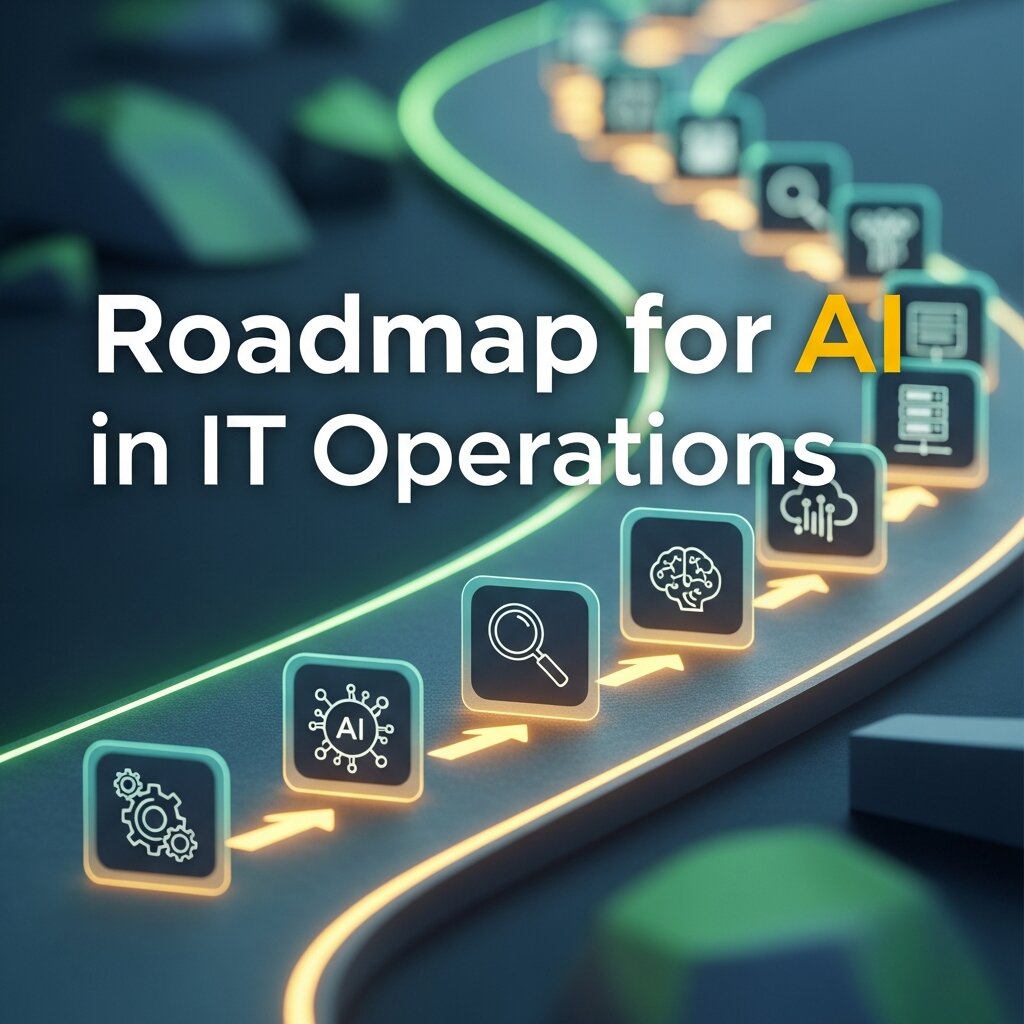
Assess Current Environment
Begin with an IT maturity audit to document existing monitoring tools, workflow processes, service level agreements, and pain points. Engage cross-functional stakeholders—from infrastructure and security teams to application owners—to identify high-impact areas for an initial AI pilot, such as critical databases or high-volume network segments.
Define Objectives and KPIs
Establish clear, measurable goals that align with business priorities. Examples include reducing mean time to resolution (MTTR) by 30%, lowering unplanned downtime by 50%, or cutting cloud expenditure by 20%. Well-defined objectives guide AI model selection and provide benchmarks for success.
Pilot and Validate
Launch a proof-of-concept in a controlled, nonproduction environment. Train AI models on relevant historical data, set alert thresholds to balance sensitivity and false positives, and simulate automated remediation workflows. Collect feedback from IT operators to refine detection rules and response procedures.
Scale Integration
Once validated, roll out AI capabilities across additional systems and sites. Integrate with service desks, chatbots, and DevOps tools to create seamless end-to-end processes. Address change management by conducting staff training sessions, updating playbooks, and fostering a culture that values data-driven decision-making.
Continuous Improvement
Regularly retrain AI models with fresh data to maintain accuracy. Schedule quarterly reviews to assess performance against KPIs, adjust automation runbooks, and incorporate new use cases. Continuous refinement ensures that AI-Enhanced IT Solutions evolve in step with emerging business needs and technology trends.
Best Practices, Pitfalls, and Emerging Trends
Maximizing the impact of AI-Enhanced IT Solutions involves adhering to proven practices while avoiding common missteps. Additionally, staying abreast of emerging trends will help organizations maintain a competitive edge.
Best Practices
- Start Small and Iterate: Focus on a single domain—such as server health monitoring or network anomaly detection—before expanding the scope.
- Ensure Data Integrity: High-quality, normalized data sets are essential for reliable predictions. Implement data cleansing and schema validation procedures.
- Maintain Human Oversight: Use AI as an augmentation to human expertise. Establish approval gates for critical actions and foster collaboration between AI models and IT operators.
- Embed Security and Compliance: Validate that all AI-driven workflows adhere to relevant standards. Regularly audit policies and incorporate guidelines from institutions like MIT security research to strengthen controls.
- Promote Cross-Functional Collaboration: Engage IT, security, and business stakeholders early to ensure shared buy-in and clear communication channels.
- Monitor KPIs Continuously: Track key metrics such as incident resolution time, resource utilization, and cost savings. Be prepared to pivot strategies as priorities shift.
Pitfalls to Avoid
- Overreliance on Automation: Fully automating high-risk tasks without proper validation can introduce new vulnerabilities. Implement staged rollouts and manual review steps for complex actions.
- Ignoring Change Management: Failing to address cultural resistance can undermine adoption. Provide training, documentation, and executive sponsorship to drive acceptance.
- Underestimating Integration Complexity: Connecting disparate tools and legacy systems can be challenging. Allocate sufficient resources for API development and compatibility testing.
- Neglecting Model Governance: Machine learning models can drift over time. Establish governance frameworks to monitor model performance, explain decisions, and retrain as needed.
Emerging Trends
- Edge AI Operations: Deploying lightweight AI agents at the network edge to deliver real-time insights for IoT and industrial environments.
- Hyperautomation: Combining AI, robotic process automation (RPA), and low-code platforms to automate complex, cross-departmental processes end-to-end.
- Explainable AI (XAI): Enhancing transparency by making AI-driven decisions interpretable to human operators, thereby increasing trust and compliance.
- AI-Native Cloud Platforms: Next-generation cloud services embedding AI capabilities natively, simplifying development and accelerating time to value.
By embracing these best practices and staying attuned to emerging trends, organizations can navigate pitfalls effectively and sustain the momentum of their AI initiatives in IT operations.
AI-Powered Cybersecurity and Threat Intelligence
 As cyber threats grow more sophisticated this year (2026), organizations are increasingly relying on AI-powered cybersecurity systems to defend their digital infrastructure. Traditional security methods often struggle to identify advanced attacks in real time, leaving businesses vulnerable to ransomware, phishing campaigns, and insider threats. AI-Enhanced IT Solutions strengthen security by continuously analyzing network traffic, login behaviors, and application activities to detect suspicious patterns before they escalate into major incidents. Machine learning algorithms can recognize anomalies that human analysts might overlook, enabling faster detection and response. Automated threat intelligence platforms also gather and process massive volumes of global security data, helping organizations stay ahead of emerging vulnerabilities. By integrating AI-driven security operations into IT management strategies, businesses improve resilience, reduce response times, and protect sensitive data while maintaining compliance with evolving regulatory requirements.
AI Integration with Hybrid and Multi-Cloud Environments
Modern enterprises increasingly operate across hybrid and multi-cloud infrastructures, combining public cloud platforms, private data centers, and edge computing systems. Managing these complex environments manually can create visibility gaps, inconsistent configurations, and rising operational costs. AI-Enhanced IT Solutions simplify multi-cloud management by delivering centralized monitoring, intelligent workload balancing, and predictive capacity planning across diverse platforms. AI systems continuously evaluate application performance, network latency, and resource utilization to determine the most efficient allocation of workloads. This dynamic optimization improves scalability while minimizing unnecessary cloud spending. Additionally, AI-driven orchestration tools automate policy enforcement, backup scheduling, and infrastructure provisioning across distributed systems. As organizations expand digital transformation initiatives in 2026, AI integration with hybrid and multi-cloud ecosystems is becoming essential for maintaining operational consistency, improving agility, and supporting long-term business scalability.
Role of AI in IT Service Desk Automation
IT service desks often face overwhelming volumes of support requests, ranging from password resets to complex infrastructure incidents. Manual ticket handling can slow response times, increase operational pressure, and reduce employee productivity. AI-Enhanced IT Solutions are revolutionizing service desk operations through intelligent automation and conversational AI technologies. Virtual assistants and AI chatbots can instantly resolve common user issues, guide employees through troubleshooting processes, and escalate complex problems to human specialists when necessary. Natural language processing enables these systems to understand user intent accurately, while machine learning continuously improves response quality over time. AI-driven ticket prioritization also ensures that critical incidents receive immediate attention based on business impact and urgency. By automating repetitive support tasks, organizations can significantly reduce service desk workloads, improve user satisfaction, and allow IT professionals to focus on strategic innovation rather than routine maintenance activities.
Future Workforce Transformation Through AI in IT
The growing adoption of AI-Enhanced IT Solutions is transforming the roles and responsibilities of IT professionals across industries. Rather than replacing human expertise, AI is augmenting technical teams by automating repetitive operational tasks and delivering deeper analytical insights. This shift allows IT staff to focus on higher-value initiatives such as strategic planning, cybersecurity governance, and digital innovation. In 2026, organizations are increasingly investing in upskilling programs that help employees develop competencies in AI management, data analytics, and automation engineering. Collaboration between humans and intelligent systems is becoming a core aspect of modern IT operations. Teams equipped with AI-powered tools can make faster decisions, resolve issues proactively, and improve overall business agility. As workforce expectations continue evolving, organizations that embrace AI-driven transformation will build more adaptive, efficient, and future-ready IT departments capable of sustaining long-term technological growth.
Frequently Asked Questions
What is an AI-Enhanced IT Solution?
An AI-Enhanced IT Solution combines machine learning, data analytics, and automation to proactively monitor and manage IT infrastructure and applications, reducing downtime and optimizing performance.
How does predictive analytics benefit IT operations?
Predictive analytics leverages historical and real-time data to forecast potential hardware failures and capacity constraints, enabling preemptive maintenance and minimizing service disruptions.
What are the risks of automating IT workflows?
While automation improves efficiency, overreliance without proper validation can introduce vulnerabilities. It’s crucial to implement approval gates and maintain human oversight for critical actions.
How do organizations measure success with AI-driven IT management?
Success is typically measured against KPIs such as reduced mean time to resolution (MTTR), lowered unplanned downtime, cost savings on cloud resources, and improved user satisfaction metrics.
Conclusion
AI-Enhanced IT Solutions represent a fundamental shift from reactive firefighting to proactive, data-driven operations. This year (2026), enterprises that implement predictive analytics, real-time automation, and intelligent optimization will see dramatic improvements in uptime, security, and cost efficiency. By following a structured roadmap—starting with targeted pilots, defining clear KPIs, and iterating continuously—organizations can build resilient, scalable IT ecosystems that support long-term growth. Begin your journey today to transform IT into a strategic asset, driving innovation and delivering exceptional user experiences in today’s fast-evolving digital world.
Read more about this topic: Best IT Consulting Solutions for Every Business Size