
Computer networking has moved well beyond cables and switches. For modern enterprises, the network is the backbone that connects employees, customers, applications, and data across the globe. When it performs well, business runs smoothly. When it falters, productivity grinds to a halt.
The challenge? Networks are growing more complex by the day. Remote work, cloud migration, and an explosion of connected devices have pushed traditional networking approaches to their limits. To keep up, IT leaders are turning to advanced techniques that promise greater speed, security, and flexibility.
This post breaks down the most important advanced computer networking techniques shaping enterprise infrastructure today. You’ll learn how technologies like software-defined networking, automation, and cloud integration work—and how they can help your organization stay competitive, secure, and ready for whatever comes next.
Why Modern Enterprises Need Advanced Networking
The way businesses operate has changed dramatically. A decade ago, most employees worked from a single office, applications lived on local servers, and the network rarely stretched beyond the building. That model is gone.
Today, the average enterprise juggles multiple cloud platforms, hundreds (or thousands) of remote endpoints, and a constant stream of data flowing in every direction. Each new connection adds complexity—and risk.
Advanced computer networking helps enterprises manage this complexity without sacrificing performance. It supports faster data transfer, tighter security, and better visibility into what’s happening across the network. Just as importantly, it lays the groundwork for innovation, allowing businesses to adopt new computer software and services without rebuilding their infrastructure from scratch.
Software-Defined Networking (SDN)
 Software-defined networking is one of the biggest shifts in enterprise infrastructure. Traditional networks rely on hardware to make decisions about how traffic moves. SDN separates the “control plane” (the brains that decide where data goes) from the “data plane” (the hardware that moves it).
How SDN Works
In an SDN setup, a centralized controller manages the entire network through software. Instead of configuring each router and switch individually, network administrators can set policies from a single dashboard. The controller then pushes those instructions out to the devices automatically.
This approach offers several clear benefits:
- Centralized control: Manage the whole network from one place, reducing manual work and human error.
- Faster changes: Roll out new policies or reroute traffic in minutes rather than hours.
- Better scalability: Add new devices and locations without overhauling your hardware.
- Cost savings: Use commodity hardware instead of expensive proprietary equipment.
Who Benefits Most from SDN
SDN works especially well for enterprises with multiple locations or rapidly changing demands. If your IT team spends hours configuring devices by hand, SDN can free up valuable time and reduce errors. Combined with custom IT solutions, it gives organizations the agility to respond quickly to business needs.
Network Automation and IT Automation Solutions
Manual network management doesn’t scale. As networks grow, the number of tasks—configuring devices, applying security patches, monitoring traffic—becomes overwhelming. This is where IT automation solutions come in.
Network automation uses software to handle repetitive tasks that once required human hands. Think of provisioning new devices, updating configurations, or responding to outages. By automating these processes, enterprises reduce errors, speed up operations, and free their teams to focus on strategic work.
Key Areas for Automation
- Configuration management: Apply consistent settings across hundreds of devices automatically.
- Monitoring and alerts: Detect issues in real time and trigger fixes before users notice.
- Security enforcement: Push patches and policy updates across the network instantly.
- Provisioning: Spin up new network resources on demand, without manual setup.
The Role of Intent-Based Networking
Intent-based networking takes automation a step further. Instead of telling the network how to do something, administrators define what they want to happen—the desired outcome or “intent.” The system then figures out how to achieve it, monitors the results, and adjusts as needed.
For example, an administrator might specify that a critical application always gets top priority. The network automatically allocates bandwidth and reroutes traffic to honor that intent, even as conditions change. This self-managing approach reduces downtime and keeps performance steady.
Cloud Networking and IT Cloud Solutions
 The shift to the cloud has transformed how enterprises think about networking. Applications and data no longer sit in one location—they live across multiple cloud providers and on-premises systems. Connecting these environments securely and efficiently is a major priority.
Multi-Cloud and Hybrid Networking
Most enterprises use more than one cloud platform. A company might run analytics on one provider, host customer apps on another, and keep sensitive data on-premises. IT cloud solutions help tie these pieces together into a single, coherent network.
Hybrid networking blends on-premises infrastructure with public and private clouds. This gives enterprises flexibility: they can keep critical workloads close while tapping into the scalability of the cloud for everything else.
SD-WAN: Smarter Wide Area Networks
Software-defined wide area networking (SD-WAN) is a standout technology for cloud-connected enterprises. Traditional WANs route all traffic through a central data center, which creates bottlenecks when employees access cloud apps. SD-WAN routes traffic intelligently, sending it directly to the cloud when appropriate.
The benefits are substantial:
- Improved performance: Direct routing reduces latency for cloud applications.
- Lower costs: Use affordable internet connections alongside (or instead of) expensive private lines.
- Greater reliability: Automatically reroute traffic if one connection fails.
- Simplified management: Control distributed sites from a central interface.
For enterprises with remote workers and multiple branches, SD-WAN delivers a faster, more reliable experience while keeping costs in check.
Network Security Techniques for the Modern Enterprise
Advanced networking and strong security go hand in hand. As networks grow more distributed, the old “castle-and-moat” approach—where everything inside the network is trusted—no longer works. Attackers who breach the perimeter can move freely, causing serious damage.
Zero Trust Architecture
Zero trust flips the traditional model on its head. The core principle: never trust, always verify. Every user, device, and application must prove its identity before gaining access, regardless of whether it sits inside or outside the network.
Zero trust relies on several practices:
- Strict identity verification: Confirm who (or what) is requesting access every time.
- Least-privilege access: Give users only the access they need, nothing more.
- Micro-segmentation: Divide the network into small zones to contain threats.
- Continuous monitoring: Watch for suspicious behavior around the clock.
Network Segmentation
Segmentation divides a large network into smaller, isolated sections. If attackers breach one segment, they can’t easily reach the rest. This containment strategy limits damage and makes it easier to monitor traffic for unusual activity. Paired with the right computer software, segmentation becomes a powerful defense against modern threats.
Network Monitoring and Observability
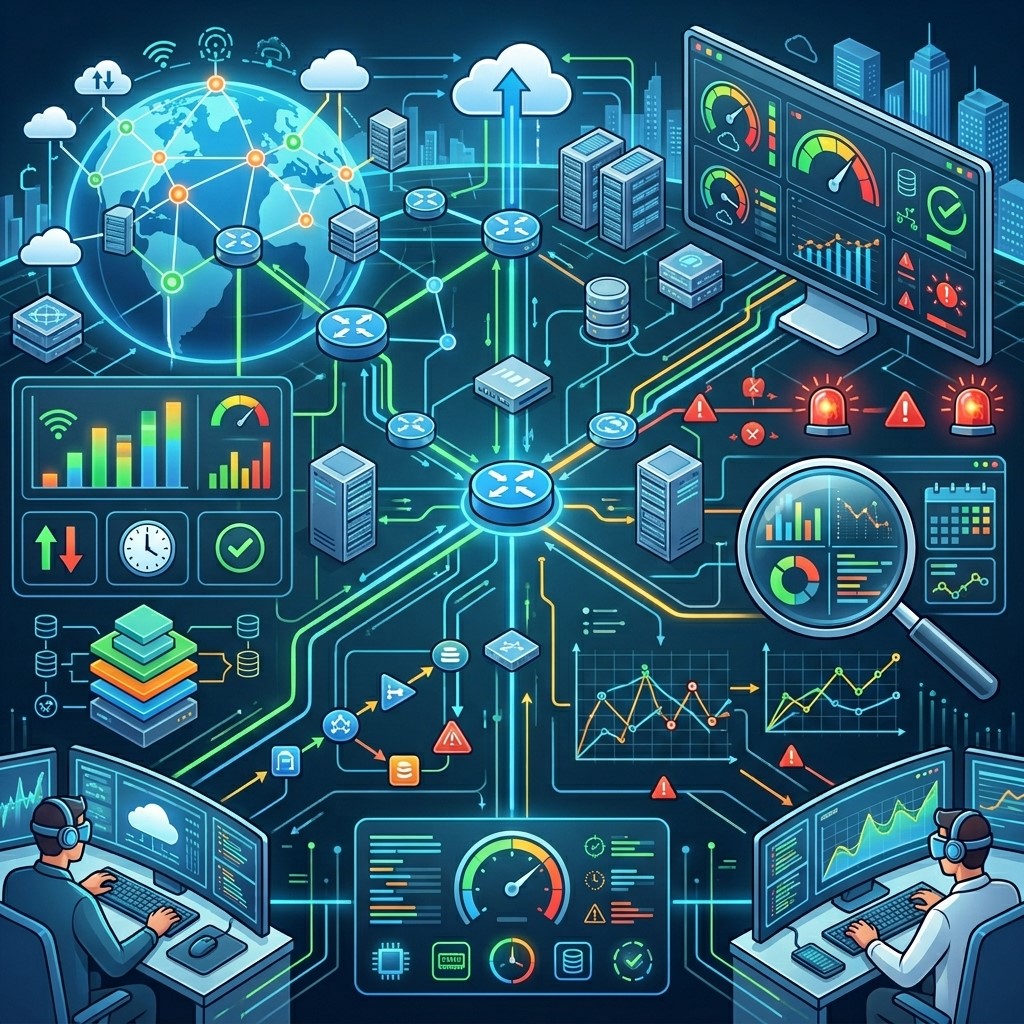 You can’t manage what you can’t see. As networks grow more complex, visibility becomes critical. Advanced monitoring tools give IT teams a real-time view of network health, performance, and security.
Observability goes beyond basic monitoring. Instead of just tracking whether systems are up or down, it helps teams understand why problems occur. By collecting data from across the network—logs, metrics, and traces—observability tools paint a complete picture of what’s happening and why.
Many of these tools now use machine learning to spot patterns and predict issues before they cause outages. This proactive approach keeps networks running smoothly and reduces the time spent firefighting. Custom IT solutions can tailor monitoring to an organization’s specific needs, surfacing the metrics that matter most.
Edge Computing and Network Performance
Edge computing brings data processing closer to where it’s generated—at the “edge” of the network—rather than sending everything to a distant data center. For enterprises dealing with massive data volumes or latency-sensitive applications, this technique is a game-changer.
Consider a manufacturing plant with hundreds of sensors. Sending all that data to the cloud for processing would create delays and consume bandwidth. By processing data at the edge, the plant gets instant insights and reduces strain on the network.
Edge computing works hand in hand with advanced networking. It requires smart routing, strong security, and reliable connectivity to function well. As more devices connect to enterprise networks, edge computing will play an even bigger role in keeping performance high and latency low.
Building a Future-Ready Network
Adopting these techniques isn’t an all-or-nothing decision. The best approach depends on your organization’s size, goals, and existing infrastructure. Here’s how to get started:
- Assess your current network: Identify bottlenecks, security gaps, and areas where manual work slows you down.
- Prioritize based on impact: Focus first on changes that deliver the biggest gains—often automation or cloud connectivity.
- Start small and scale: Pilot new techniques in one area before rolling them out across the organization.
- Invest in the right tools: Choose computer software and IT automation solutions that fit your team’s skills and your business needs.
- Plan for security from the start: Build zero trust principles into every networking decision.
Working with experienced partners who offer custom IT solutions can smooth the transition, especially for organizations without deep in-house networking expertise.
FAQ: Advanced Computer Networking
1. What is advanced computer networking?
Advanced computer networking uses modern technologies like SDN, automation, cloud networking, and edge computing to improve network performance, security, scalability, and flexibility, helping businesses manage complex IT environments efficiently.
2. How does Software-Defined Networking (SDN) improve enterprise networks?
SDN centralizes network management through software, allowing administrators to configure devices quickly, reduce manual errors, improve scalability, and respond faster to changing business and network requirements.
3. What is network automation, and why is it important?
Network automation uses software to automate repetitive tasks like configuration, monitoring, and updates. It saves time, reduces errors, improves efficiency, and allows IT teams to focus on strategic initiatives.
4. What are the benefits of cloud networking?
Cloud networking offers scalability, flexibility, cost savings, and easier remote access. It enables businesses to connect applications and data across multiple environments while improving performance and supporting digital transformation.
5. What is SD-WAN, and how does it differ from traditional WAN?
SD-WAN uses software to intelligently route network traffic, unlike traditional WANs that rely on fixed paths. It improves cloud application performance, reduces costs, increases reliability, and simplifies network management.
6. What is Zero Trust Architecture?
Zero Trust Architecture is a security model that requires continuous verification of users and devices. It limits access privileges, prevents unauthorized entry, and strengthens protection against cyberattacks and data breaches.
7. Why is network monitoring important for enterprises?
Network monitoring provides real-time visibility into performance and security. It helps detect issues early, prevent downtime, optimize resources, and maintain a stable, secure, and efficient network environment.
8. How does edge computing improve network performance?
Edge computing processes data closer to its source instead of sending it to distant servers. This reduces latency, saves bandwidth, speeds up response times, and supports real-time applications effectively.
9. How can businesses transition to advanced networking technologies?
Businesses should assess current infrastructure, identify needs, start with small projects, invest in suitable tools, and prioritize security to ensure a smooth and cost-effective transition to advanced networking.
10. Which advanced networking technology should enterprises adopt first?
The ideal technology depends on business goals. Companies often start with network automation, SD-WAN, or Zero Trust security because these solutions provide immediate improvements in efficiency, connectivity, and protection.
Take Your Enterprise Network to the Next Level
Computer networking has become a strategic asset, not just a back-office function. The enterprises that thrive are those that treat their networks as a foundation for growth—investing in software-defined infrastructure, automation, cloud integration, and robust security.
The techniques covered here—SDN, network automation, cloud networking, zero trust security, observability, and edge computing—give modern enterprises the tools to stay fast, secure, and adaptable. You don’t need to adopt everything at once. Start with the changes that address your biggest pain points, then build from there.